
Franklin County Warrant Checks
Check the court name before anything else. Franklin County publishes no single all-warrant search, so a warrant check has to start where the case was filed. The countywide Justice of the Peace takes county and precinct fine-only matters. Mount Vernon and Winnsboro each handle their own city citations. County Court keeps its files, and the 8th and 62nd District Courts keep theirs. For execution, custody, or bond questions, the Sheriff's Office is the local number to call. Before you dial, gather the person's legal name, date of birth, the court or city involved, any citation or cause number, and the missed appearance date if you know it. Ask the clerk for the exact process label and which office controls the next step. One court's answer does not cover every Franklin County court, so check each one that might hold the case.
- Match the paper or notice to the issuing court. County traffic matters go to the JP; city tickets go to the named municipal court.
- Call that court with the citation or cause number and ask whether a new date, payment, written response, or hearing is required.
- For a felony file, contact the District Clerk or the named district-court coordinator at Annex West.
- Call the Sheriff/Jail for execution or custody details. Its page does not offer a public warrant search.
- Use a focused Texas Public Information Act request for a specific existing record that is not online.
- For a license-renewal hold, contact each reporting court, then use DPS or OmniBase for the reported FTA/FTP information.
The longer office-by-office route appears on the Franklin County warrant check page.
Checking the Countywide JP
One countywide Justice of the Peace office serves Franklin County, rather than four separate precinct desks. Judge Robert W. Zinn presides from the courthouse at 200 N. Kaufman Street in Mount Vernon, and the office answers at 903-537-2342 extension 1 or jpoffice@co.franklin.tx.us. The official page links fine payment and forms. It offers no public warrant-status form, though. On a county or precinct citation, ask the JP clerk directly whether the matter is still just a citation, has picked up a failure-to-appear or arrest-warrant entry, or has turned into a capias pro fine after judgment. The JP controls its own case process, so the clerk's word governs. A payment link may settle an ordinary fine, but only the clerk can say whether a judge appearance or recall order comes first. Get a written receipt or status note, and ask for the next court date. The JP contact page carries the office details and its public links.
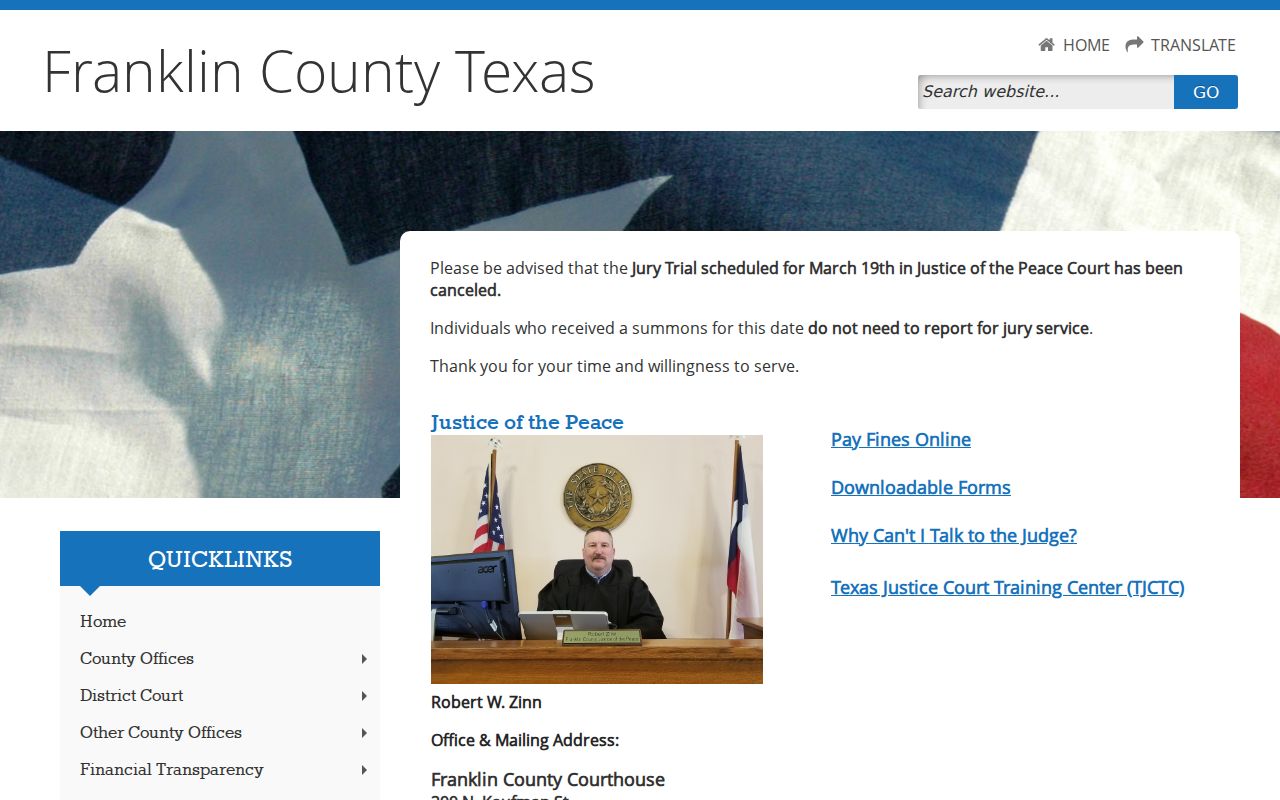
Confirm current Franklin County JP contact details on the court page before sending any payment or form.
Warrants in Franklin County: The Main Types
Which court to call depends on the order and why it issued. A capias pro fine comes after a fine or costs judgment. That is a different animal from an arrest warrant based on probable cause. A missed setting can produce a failure-to-appear warrant, a capias, or some other court process. In Franklin County, the JP and municipal courts handle fine-only cases, County Court handles county-level criminal matters, and felonies route to a district court.
| Process | How it arises | First office |
|---|---|---|
| Arrest warrant | A magistrate finds a lawful basis to direct an arrest | Issuing court, then serving officer |
| FTA or bench process | A required setting or court response is missed | Court that set the case |
| Capias pro fine | A fine or costs judgment remains unpaid | JP or municipal court |
| Search warrant | A judge authorizes a search on probable cause | Issuing court; access may be restricted |
Why One County Search Is Missing
The Franklin County Sheriff page posts a phone, an address, and a link to the DPS sex-offender search. It posts no warrant search and no active-warrant roster. That gap is a limit of the public page, not proof that an office holds no record. Texas Crime Information Center data stays restricted to law enforcement, and Texas runs no single public statewide warrant query. So work the issuing court first. Then ask the Sheriff or jail what it can confirm about execution or custody. Mount Vernon and Winnsboro keep their city-court matters separate. When a name comes up empty or the record is not online, the county's own records-request form is another route. One caution: the sheriff's sex-offender link is not a warrant tool. The official sheriff page holds that contact route and its published links.
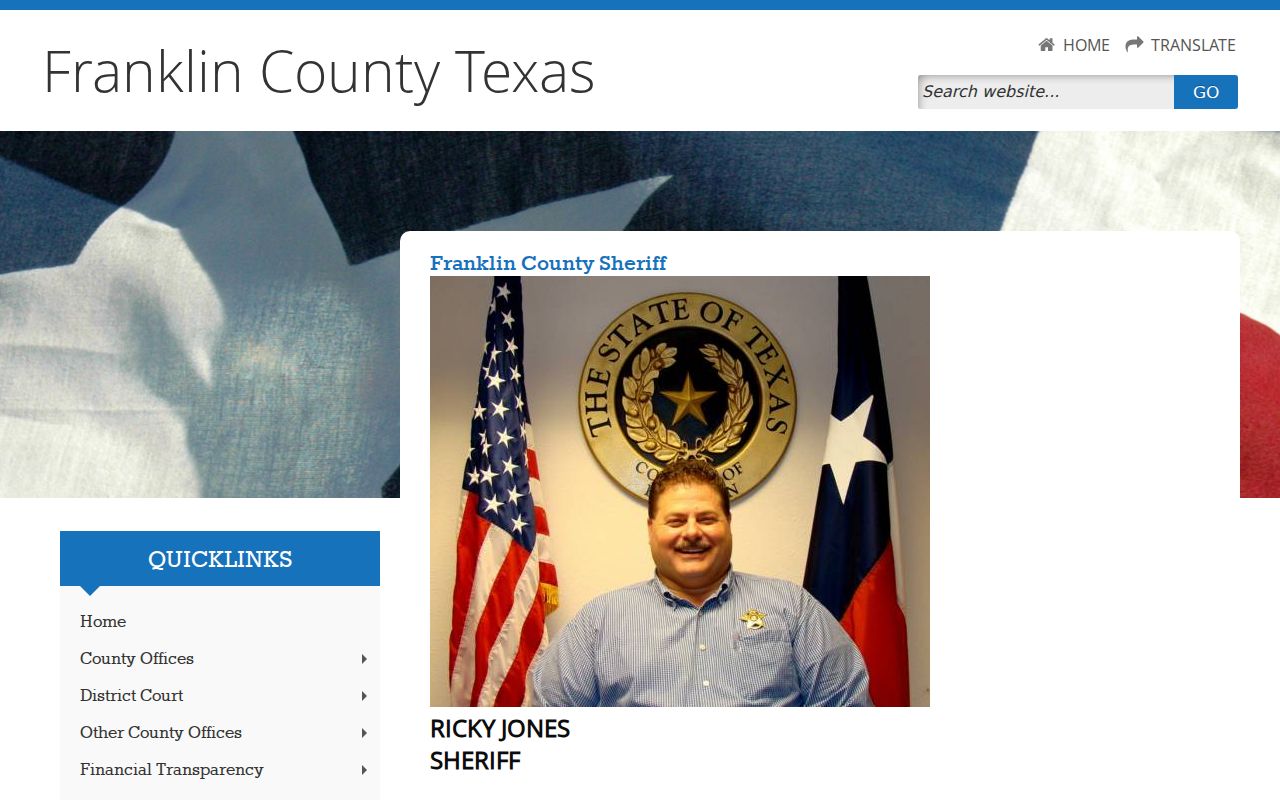
The county page points to a phone-first confirmation path for Franklin County, not to any online warrant roster.
Franklin County Warrant Records: What They Show
A court or law-enforcement record can list the cause or citation number, issuing court, charge, setting, bond, status wording, serving agency, and key dates. The public County Court docket sample carries a cause pattern like CR-###-YY. That is a docket format only, not a confirmed warrant-number format. Franklin County publishes no local status-code list or sample warrant.
| Case number | Use the cause or citation number given by the court; the docket pattern is not a warrant ID. |
|---|---|
| Issuing court | District Court, County Court, countywide JP, or a named city court. |
| Charge and setting | The docket may show an offense label and court date. |
| Bond or balance | Case-specific amount or bond source; Franklin County publishes no general bond schedule. |
| Current status | Ask the issuing court whether the process is active, served, recalled, or cleared. |
Reading a Franklin County Docket
Franklin County posts dated docket PDFs for the district courts and County Court. A docket can show the case number, setting, charge, attorneys, total bond, bond source, case flags, comments, and print time. That helps you identify the court and the case. It is not a live warrant roster, and a printed page may lag a later setting, service, payment, or recall. Start with the official docket archive to find the right court material. Then call the clerk for current case status. The archive holds dated court schedules, not person-level warrant status.
Franklin County Cause Numbers Are Docket IDs
In Franklin County, a criminal case carries a cause number in the pattern CR-###-YY. That number is a docket ID. No separate countywide warrant-number format exists. Take the cause number to the right clerk or docket, then ask that court to confirm any active warrant tied to it. The warrant document and its service entry may sit elsewhere in the case file.
Franklin County Warrants: Who Issues, Who Serves
Franklin County splits the work. Judges issue warrants and decide what ends them. Officers with lawful authority handle service. The Franklin County Sheriff/Jail sits at 208 TX Hwy 37 in Mount Vernon, and 903-537-4539 reaches staff for custody, execution, or bond questions. No published bond schedule, warrant-unit line, or named surrender window exists here, so call before you show up and ask where to report.
Franklin County Sheriff's Office / Jail
208 TX Hwy 37, Mount Vernon, TX 75457
903-537-4539
Felony files live with the District Clerk at Annex West, 204 Texas Highway 37. The Franklin County courts and sheriff sit nearby, but each office holds a different piece of the process.
Franklin County's Annex West Route
Franklin County shifted its district side of town. A 2025 county notice placed the District Clerk and the 8th and 62nd District Courts at Annex West, 204 Texas Highway 37. The old 200 N. Kaufman courthouse still handles JP, County Court, County Clerk, and county administration business. Don't treat the District Clerk's P.O. Box 750 as a reason to mail a warrant question. Confirm the right filing or records process first. For anything in district court, ask the District Clerk which coordinator or judge's office holds the file. The official relocation notice names the current physical location. County and city matters follow the court printed on your paperwork instead. Match the address to the court that issued the process.
Handling a Franklin County Warrant
Start by learning which court issued the warrant. Then ask the clerk what options exist: a new setting, a payment plan, a motion to recall or quash, an appearance arranged through an attorney, or bond. Fine-only capias pro fine matters open more doors in Franklin County, including payment, community service, an undue-hardship hearing, and the Chapter 45A good-faith resolution rules. A surrender or booking could still happen. Call the Sheriff/Jail first and ask where and when to report. No guaranteed walk-through procedure is published.
Important: A lawyer can contact the issuing court, confirm the case, and discuss a planned appearance before you act on an uncertain online result.
Keep your paper trail. That means the court receipt, any written order, your next date, and confirmation of any separate sheriff or DPS update. Paying a balance alone does not prove the warrant was recalled or the case closed.
Chapter 45A for County Capias Pro Fines
Chapter 45A sets duties for fine-only cases. A justice or municipal court handling a capias pro fine must weigh undue hardship, and the chapter describes recall duties when someone requests a hearing or appears voluntarily with a good-faith effort before execution. Ask the Franklin County issuing court what documentation and appearance method it accepts. A payment-plan form by itself is silent. It does not show whether the judge has recalled the process.
OmniBase Is Not a Warrant Search
OmniBase is not a warrant search. The DPS Failure to Appear/Failure to Pay Program can block license renewal once a reporting court sends notice of an unpaid judgment or a missed court date. Think of it as a license-compliance channel. It is not a complete warrant index. DPS points people back to the court that reported each citation, and if more than one court reported a matter, each one must be handled separately. DPS says a driver record can take three to five business days to update after a court reports compliance. Ask the court directly whether the matter is paid, whether you must appear, and when the update goes out. The DPS program page lists OmniBase at 1-800-686-0570. A license hold and a Franklin County arrest or capias status are different records in different systems.
Warrant Record Access Under Texas Law
The Texas Public Information Act opens records held by governmental bodies, with exceptions. Franklin County's request form asks for a specific record and notes that the office need not do general research for you. So name the record holder, the case or citation number, the date range, and the document you want. Expect refusals or redactions for a live investigation, a sealed file, a protected identifier, or a juvenile record.
Key rules:
Texas Government Code Chapter 552 gives access to existing public information, with statutory exceptions.
Texas Code of Criminal Procedure Chapter 15 sets arrest-warrant requirements.
Texas Family Code Section 58.010 makes a child's arrest warrant and supporting complaint or affidavit confidential, subject to listed exceptions.
The county's public-information form keeps a request focused. Franklin County generally answers promptly and ordinarily within ten business days, though a lawful exception can delay release.
City Warrant Records in Franklin County
City tickets and ordinance cases belong to the municipal court that issued them. The 2020 Census put Winnsboro at 3,455 residents and Mount Vernon at 2,491. Winnsboro's city limits cross into Wood County, so a Winnsboro ticket stays a city-court question rather than an automatic Franklin County JP case. Mount Vernon holds the county seat. It runs its own municipal court alongside the county offices.
Winnsboro Warrant Search
Population 3,455 · City Police is open 24/7; its court handles city citations and requests.
Mount Vernon Warrant Search
Population 2,491 · Municipal Court handles city traffic, parking, and ordinance cases.
For confirmation routes and the sheriff's list situation, see the Franklin County most-wanted reference. It covers the local gap and points to official contacts, without hosting names.